Because moving walkways transport millions of individuals daily—many of whom are encumbered with luggage, children, or physical limitations—they are bound by rigorous international safety standards. The structural integrity and sensor redundancy of these systems dictate overall facility liability. Understanding these compliance frameworks is mandatory for engineers, architects, and facility managers.
Global Regulatory Frameworks
While local building codes provide specific nuances, the global standard for escalators and moving walks relies heavily on two primary texts:
- EN 115 (European Standard): This standard covers safety rules for the construction and installation of escalators and moving walks. It outlines everything from the permissible dimensions of pallet grooves to structural load testing parameters.
- ASME A17.1 (North American Standard): The Safety Code for Elevators and Escalators in the US and Canada strictly governs mechanical safeguards, electrical redundancies, and mandatory maintenance intervals.
Critical Safety Mechanisms
To adhere to EN 115 and ASME A17.1, manufacturers build layered safety redundancies into the walkway framework. These include mechanical stoppers, electrical sensors, and passenger-facing emergency overrides.
1. Comb Plate Safety Switches
The most vulnerable interaction point on a moving walkway is the transition where the moving pallets meet the stationary floor, mediated by a grooved comb plate. If a foreign object (like a shoelace or a luggage strap) becomes wedged between the comb teeth and the moving pallet, the comb plate is designed to shift slightly backward or upward. This micro-movement immediately triggers a safety switch, killing the motor circuit and applying the mechanical brake within fractions of a second to prevent entrapment.
2. Handrail Speed Synchronization
It is a regulatory requirement that the rubber handrail moves at identical speeds to the walking surface. If the handrail lags or outpaces the pallets by an unacceptable margin (typically beyond a 2% deviation), passengers may lose their balance. Built-in tachometers constantly measure both speeds. A prolonged deviation triggers a safety shutdown.
3. Missing Pallet Detection
If a pallet structural failure occurs internally, creating a gap in the moving track, it poses a catastrophic fall hazard. Optical or mechanical sensors mounted inside the truss continuously scan the returning track. If a pallet is missing, the system locks the walkway before the gap can reach the passenger-facing side.
4. Emergency Stop Switches
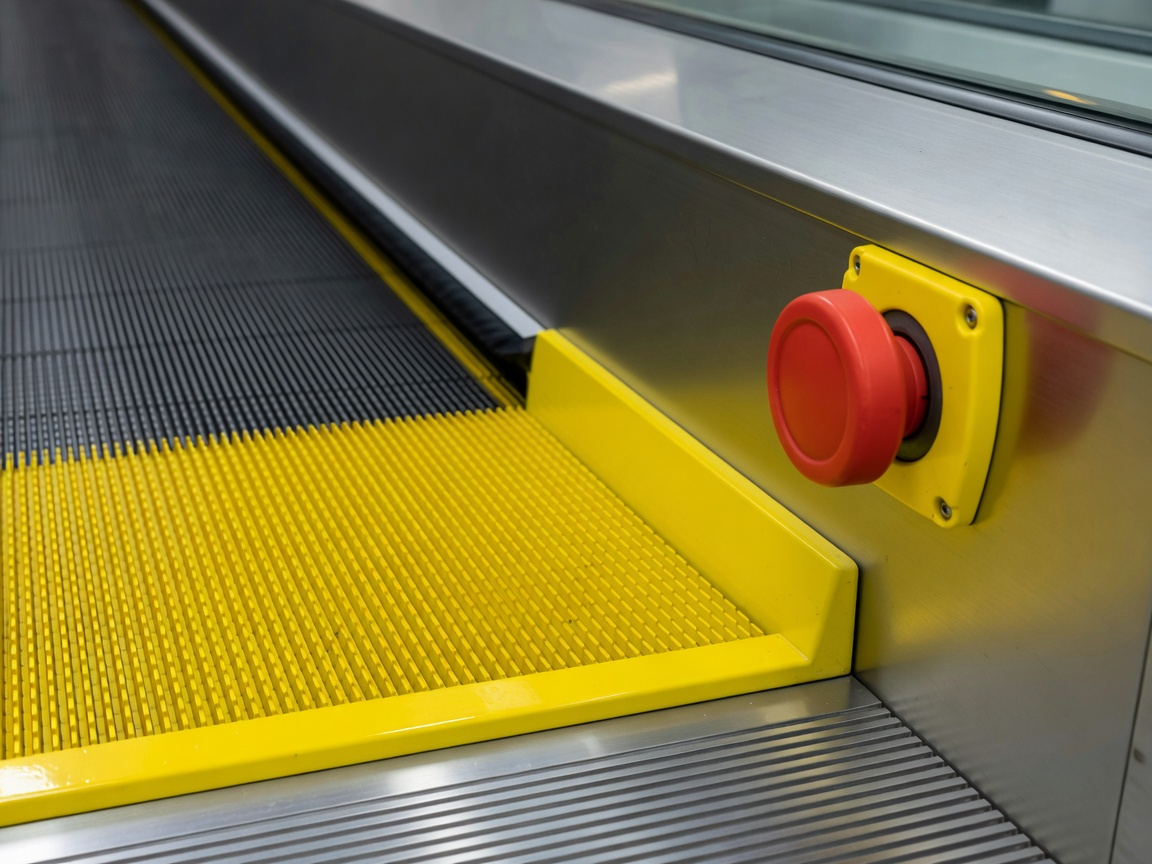
Mandated at both the entry and exit points (and frequently at intervals on exceptionally long auto-walks), prominent red emergency stop buttons allow passengers or staff to halt the machinery immediately. These circuits are hard-wired in a failsafe loop; cutting the circuit engages the brakes without relying on complex software processing.
Anti-Reversal and Overspeed Governors
Particularly critical on inclined walkways, anti-reversal devices prevent the machine from accidentally running backward under heavy load if the primary drive chain snaps. Overspeed governors simultaneously monitor motor output, dropping the main brake if gravity or motor failure causes the pallets to exceed their rated operational speed.